
How to Find Target Companies to Sell To with AI
Apollo and Clay are great if your ICP fits neatly into a set of dropdown filters. Industry, employee count, location, funding stage. You can build a list in minutes.
But the highest-signal prospecting criteria usually do not fit in a dropdown. The companies worth reaching out to right now are often defined by behavior, timing, and context: who just started hiring, who has not updated their blog in months, who serves a niche customer segment, or who seems ready for a GTM motion but has not built one yet.
How most people do this manually
You can filter for "SaaS companies with 10-50 employees in New York." You cannot filter for:
- Companies that just posted a job for their first sales hire
- Marketing agencies that work with DTC brands and have fewer than 20 people
- Law firms in Boston that do not have an in-house marketing person
- SaaS companies using HubSpot whose blog has not been updated in 6 months
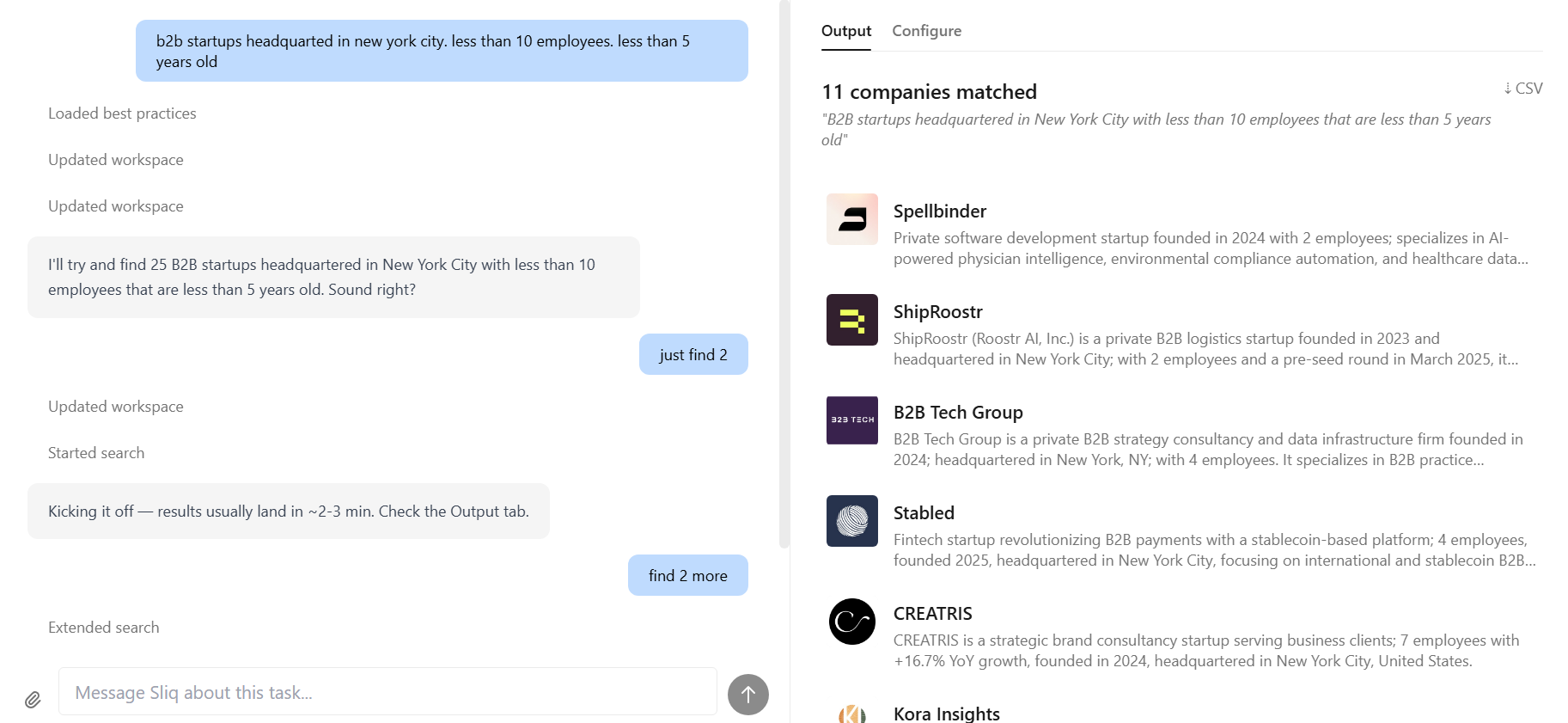
- B2B startups with fewer than 10 employees that are less than 5 years old
These are the criteria that actually tell you whether a company is a good fit right now. They are behavioral, contextual, and time-sensitive, and no database has a checkbox for all of them.
So people run the closest approximation in Apollo, pull a list of 200 companies, and then spend hours manually checking each one against the criteria that actually matter. The database gets you 60% of the way there. The other 40% is you clicking through LinkedIn profiles and company websites at 11pm.
What this looks like with a Sliq agent
You describe what you are looking for the way you would describe it to a human:
B2B startups headquartered in New York City. Less than 10 employees. Less than 5 years old.
Or something no filter can handle:
Find me marketing agencies in the US that work with e-commerce brands, have under 20 employees, and do not seem to have anyone doing outbound sales for them.
The agent confirms what it understood, searches across public sources, and comes back with a structured list:
- Company name
- Description
- Website and relevant source links
- Why the company matched your criteria
- Notes on any ambiguous signals
- CSV export
Want to refine the list? Just say so. "Exclude consulting firms." "Find 10 more like these." "Also check if they have raised funding." The agent adjusts without forcing you to rebuild a search from scratch.
Why a Sliq agent isn't just a better company database
Apollo and Clay are filter-based. You search within the boundaries of their schema: the fields they have decided to index. If your criteria does not map to a field, you either approximate it or check everything manually.
A Sliq agent works more like a research assistant. It reads websites, cross-references job postings, checks LinkedIn activity, and synthesizes context that no single database captures. Because it understands plain language, you do not need to translate your ICP into boolean filters or enrichment recipes. You describe the companies you want, and the agent does the research.
It also stays current. Set it to re-run weekly, and your target company list refreshes automatically. No more quarterly list-building sprints that go stale by the time you start outreach.
Delegate this to a Sliq agent ->
Related workflows
- Find the right people to reach out to with AI if you already know the accounts and now need the best contacts inside them
- How to Automate LinkedIn Outreach with AI if you want to turn your target account list into active outreach
- How to Monitor Reddit with AI if you want to find target companies from live market conversations and buying signals
Frequently asked questions
How is this different from Apollo or Clay?
Apollo and Clay are powerful tools built around structured filters such as industry, company size, location, and technographics. They work well when your ICP maps cleanly to those fields. A Sliq agent handles the criteria that do not fit in a filter: behavioral signals, contextual clues, and qualitative attributes that require actually reading a company's website, job posts, or social activity.
Where does the agent find these companies?
It searches across multiple public sources, including company directories, LinkedIn, job boards, funding databases, news, and company websites. You do not have to know which source to check for what. The agent cross-references them against your criteria and explains why each company matched.
Can I export the results?
Yes. Every search produces a structured list you can export as CSV or send directly to your CRM, Google Sheet, or Notion doc.
Can it track changes over time?
Yes. Set the agent to re-run your search on a schedule: weekly, biweekly, or whatever cadence makes sense. It will flag new companies that match your criteria and note any changes to companies already on your list.
Last updated: April 2026