
How to Automate SEO Content Writing with AI
Writing one SEO article is manageable. Running a consistent SEO content program is where things break.
You need topics, keywords, research, sources, outlines, drafts, meta descriptions, FAQs, internal links, formatting, publishing, and a way to keep the calendar from going stale. Most teams do a burst of content planning, publish a few posts or guides, and then stop when the queue runs dry.
AI can help, but only if it owns more than the blank page.
If you ask an AI content writer for "a post about sales prospecting," you get generic SEO content. If you give a Sliq agent your positioning, writing samples, content goals, destination, and source requirements, it can run the workflow around the writing.
How most people do this manually
A real SEO content workflow has a lot of steps:
- Decide what topics are worth writing
- Group topics into content pillars
- Match each topic to search intent
- Pick the next article, guide, comparison, or checklist from the calendar
- Research what already ranks
- Find sources, stats, and examples
- Draft the content with useful structure
- Add a meta description
- Add FAQ questions and answers
- Include internal links
- Format the draft for a CMS, Google Doc, Notion, or workspace
- Track what has already been published
- Replenish the content calendar before it dries up
Most AI writing tools only help with one piece: drafting. That can save time, but it does not solve the operating problem. You still have to decide what to write, check whether the content is useful, add sources, and remember what is next.
What this looks like with a Sliq agent
You give the agent the context a content operator would need:
We sell an AI GTM assistant to early-stage B2B teams. Our audience is founders and GTM leads. Here are our writing samples, competitors, and topics we want to own. Publish drafts to Notion and keep the calendar topped up.
The agent can then handle the repeatable workflow:
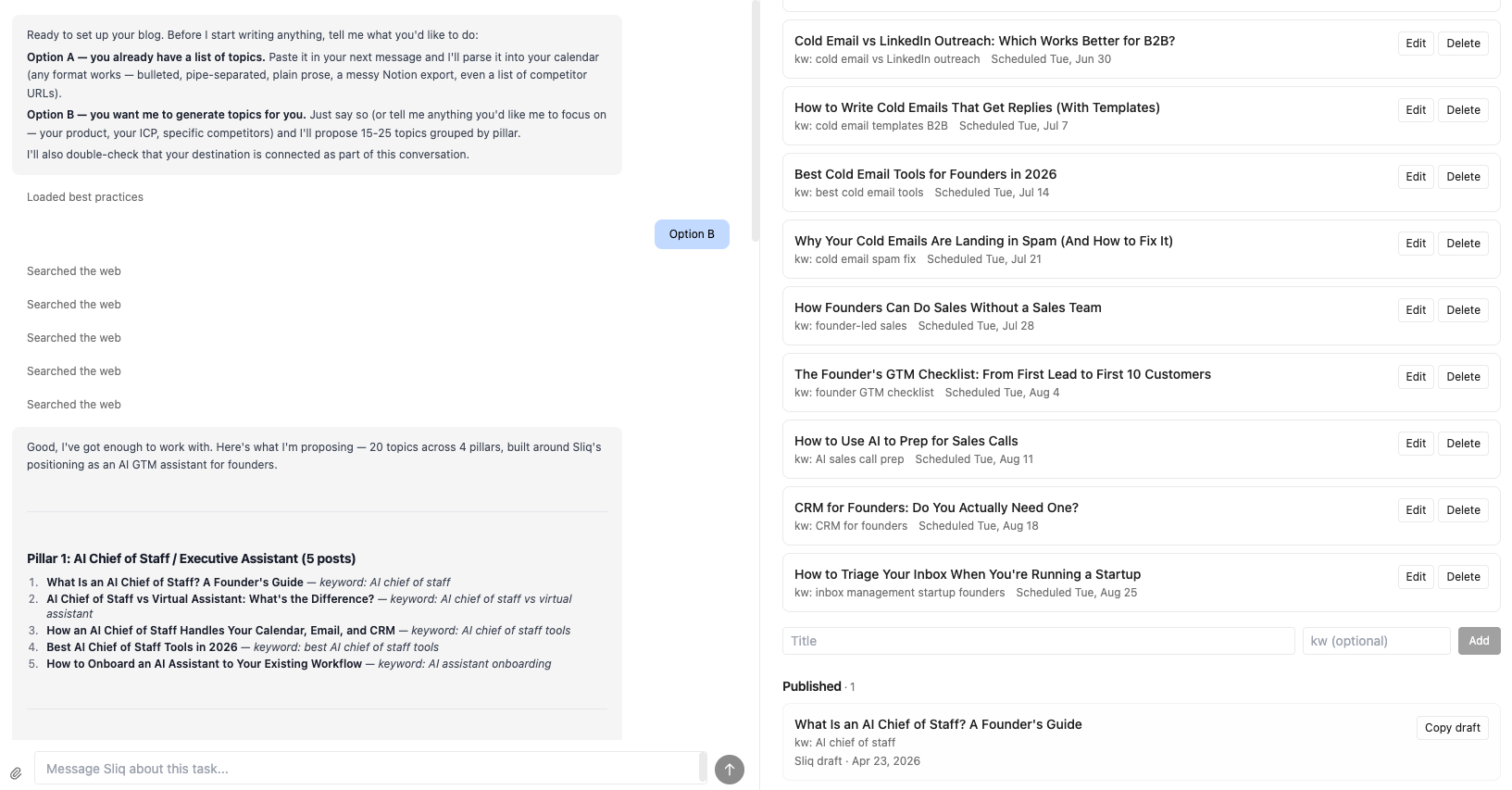
- Builds a content calendar across 3-5 pillars
- Suggests topics by buyer stage: awareness, consideration, decision, and implementation
- Mines search results, Reddit, Quora, competitor blogs, and public sources for real demand signals
- Picks the next unpublished topic from the queue
- Researches sources before drafting
- Writes SEO content with keyword placement, H2 structure, key takeaways, and FAQs
- Adds source links and specific claims where useful
- Formats the post for Google Docs, Notion, or the Sliq workspace
- Tracks published posts so topics are not repeated
- Replenishes the calendar when the queue gets low
You review the output, edit the strategy when needed, and approve the drafts that are ready. The agent keeps the machine moving without asking you to rebuild the process every week.
Why a Sliq agent isn't just another AI content writer
Most AI content writers optimize for a single output: enter a topic, get a draft.
That is useful, but it is not enough for SEO. A good content program needs a queue, topic strategy, source discipline, internal linking, publishing rules, and duplicate avoidance. It also needs each piece to say something specific enough to be worth reading.
A Sliq agent works like a content operator. It can remember the calendar, choose the next topic, research the SERP, cite sources, add FAQ sections, and publish to the destination you chose. It can also learn your voice from writing samples and follow rules about topics, phrasing, and claims to avoid.
The human still owns the point of view. You provide positioning, product context, examples, and approvals. The agent handles the parts that make publishing consistently hard.
Delegate this to a Sliq agent ->
Related workflows
- How to Automate LinkedIn Post Writing with AI if you want to repurpose the same ideas into a LinkedIn content engine
- How to Monitor Reddit with AI if you want to mine Reddit for topics, questions, and demand signals
- Find target companies to sell to with AI if you want content insights and prospecting research feeding the same GTM workflow
Frequently asked questions
Can AI automate SEO content writing?
AI can automate large parts of SEO content writing, including topic ideation, content calendar planning, research, outlining, drafting, FAQ creation, formatting, and publishing. It still needs product context, writing samples, source requirements, and human approval to avoid generic content.
How is a Sliq agent different from an AI content writer?
Most AI content writers generate one draft from one prompt. A Sliq agent manages the workflow around the content: building the calendar, selecting the next topic, researching sources, drafting, checking SEO requirements, adding FAQs, publishing to the right destination, and replenishing the queue.
What does the agent need before writing SEO content?
The agent needs product positioning, ideal customer context, writing samples, content pillars or topic ideas, destination settings, and any rules about tone or topics to avoid. Better inputs produce more specific posts and reduce generic AI copy.
Can the agent publish SEO content to Google Docs or Notion?
Yes. A Sliq agent can publish finished drafts to Google Docs, Notion, or the Sliq workspace depending on the destination you choose. It can also maintain a queue of published and upcoming content so duplicate topics do not get written twice.
Last updated: April 2026